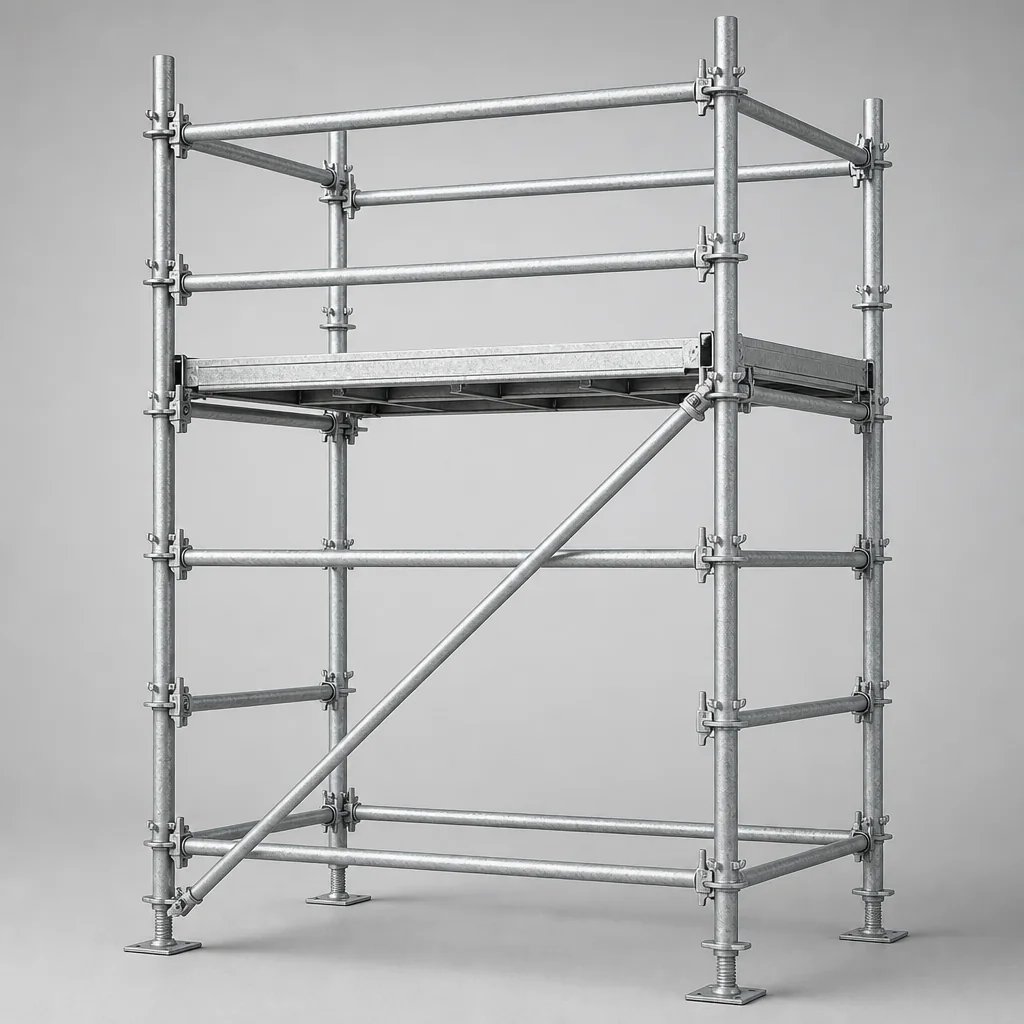
Kwikstage scaffolding is the modular steel access system built around a vertical tube with welded star clips, into which horizontal members drop and lock with a wedge pin. There are no loose couplers, no bolts and no separate fasteners on the primary connections: one worker positions the component and taps the wedge home. That single design decision is why the system is still specified on repetitive façade, refurbishment and shoring work decades after it was introduced.
For a Gulf buyer the name itself is the first problem to solve. Kwikstage is sold and searched under at least half a dozen spellings and aliases — quickstage, Q-stage, kwickstage, kstage, and in shoring applications star shore or speed shore. Two enquiries describing the same product can arrive under different names, and a quotation written against the wrong alias can specify components that will not connect on site.
This guide covers what a GCC contractor, rental fleet owner or steel trader needs to decide before placing a kwikstage order: which components you are actually buying, the tube specifications and tolerances that govern whether the system is interchangeable with your existing fleet, the standards that a Gulf site approval will reference, how the system compares with ringlock and cuplock, how it loads into containers, and how to vet a supplier so the documentation arrives with the steel rather than after it.
1. What Kwikstage Scaffolding Is, and How the Connection Works
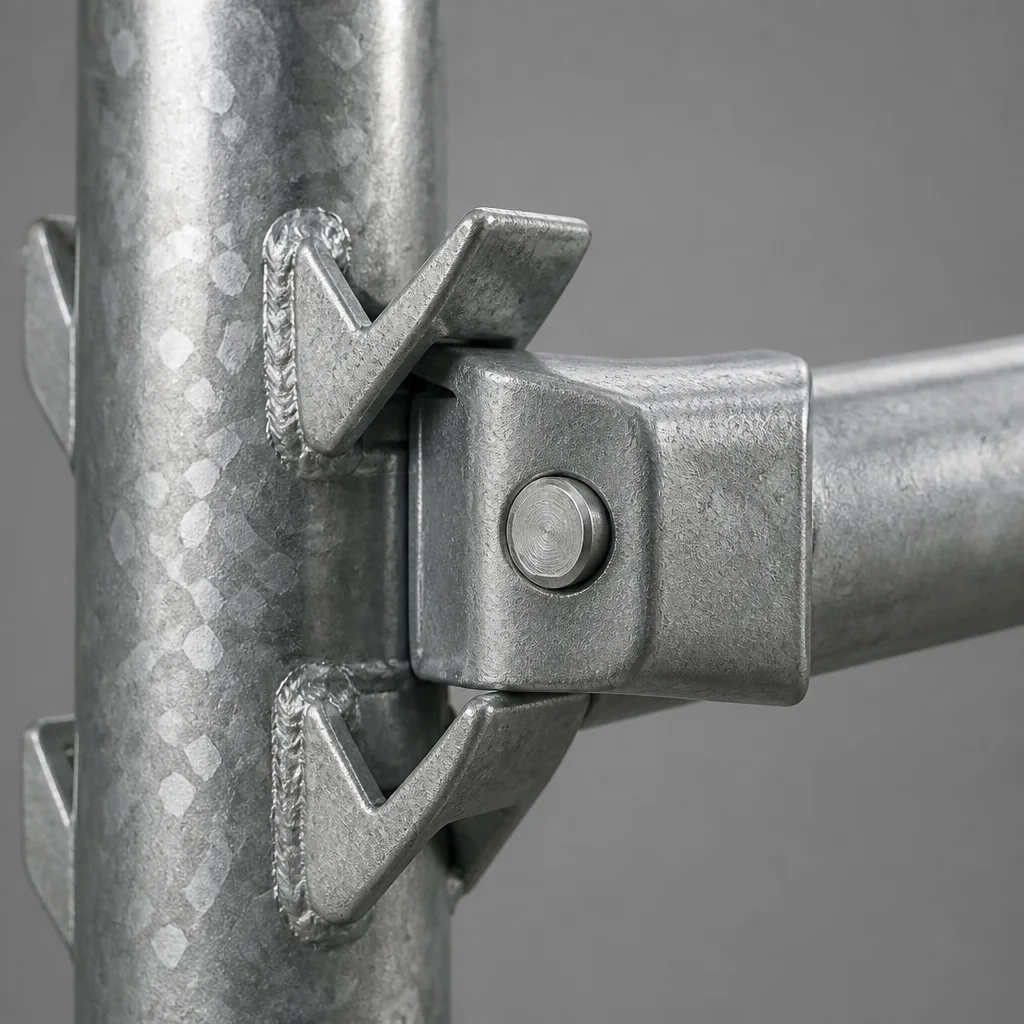
The distinguishing feature of kwikstage is the star clip — a set of pressed V-shaped lugs factory-welded to the vertical tube (the “standard”) at fixed intervals, normally 500 mm. Horizontal and diagonal components terminate in matching wedge housings. Assembly is therefore a drop-and-wedge operation rather than a bolt-and-tighten operation.
That is the whole system in one sentence, but it has three commercial consequences that matter more than the mechanism itself:
- Fewer loose parts on site. Tube-and-coupler scaffolding consumes two couplers at every node, and those couplers are the components most often lost, over-tightened, stripped or stolen across a project. A kwikstage node consumes one wedge pin that stays captive on the ledger or transom. Fleet auditors consistently find that this is the single largest driver of consumable replacement cost in a tube-and-coupler fleet, and it is the reason rental companies in high-labour-cost markets converted early.
- Assembly speed depends less on skill. Because the connection is position-and-wedge, an inexperienced crew reaches productive output faster than on a coupler system where correct tightening torque is a genuine skills requirement. On Gulf projects where erection is subcontracted and the crew changes between phases, that reduces the variance in both programme and quality.
- The system is not fully open. Star clip spacing, ledger end geometry and wedge housing dimensions are proprietary in detail. Components from two manufacturers usually connect, but not always, and never with a guarantee. Section 4 explains what to measure before you assume interchangeability with an existing fleet.
The components that make up a working kwikstage frame are described in Section 3. First, it is worth being clear about where the system stands in the Gulf market today, because that determines how much of a project it should carry.
2. Where Kwikstage Fits in the Gulf Market in 2026
The Gulf access market is growing, and it is growing unevenly across systems — which is exactly the situation in which a buyer should be deliberate about which system to buy rather than defaulting to whatever a subcontractor already owns.
The Saudi Arabian scaffolding market was projected at USD 256 million in 2025 and USD 275 million in 2026, expanding to USD 420 million by 2031 — a CAGR of 8.84% between 2026 and 2031. Underneath that headline, the system mix is shifting. Supported scaffold held 66% of the market by type in 2025, while modular / ringlock held 44% by system and recorded the highest forecast growth at a 10.3% CAGR. Mobile scaffold is the fastest-growing type at 9.6% CAGR as projects move from structural work into fit-out and maintenance.
Two demand layers support those numbers and behave differently:
- Vision 2030 construction. Construction sector GDP rose 4% year on year in Q4 2025, and the activity is spread across transport, urban expansion, hospitality and redevelopment rather than concentrated in one corridor. Spread demand favours suppliers whose equipment can be redeployed between cities as phases change.
- Oil, gas and industrial maintenance. Saudi Aramco reported capital investment of USD 52.2 billion in 2025 and guided USD 50–55 billion for 2026, which keeps turnaround and maintenance demand running in the Eastern Province independently of new-build cycles. The scale of that channel is visible in projects such as the Zuluf onshore facilities, where more than 200,000 m² of suspended scaffold was erected with a peak deployment above 1,200 tons of material across 34 project-specific scaffold designs.
Two restraints shape how you buy. Routine construction is intensely price-competitive, particularly in standard tube-and-coupler applications and short-duration urban work. And the market depends on imported components, which exposes buyers to freight, currency and lead-time risk. Kwikstage sits in the middle of this picture rather than at either extreme. It is not the largest system segment in the Gulf — ringlock carries that distinction and is winning on engineered, documented, high-value projects. Kwikstage’s advantage is concentrated where a project is repetitive, moderate in complexity, and cost-sensitive on labour rather than on documentation depth: residential and low-rise commercial façades, refurbishment and re-cladding, industrial maintenance access, and shoring to slab and beam soffits.
3. The Components You Are Actually Buying
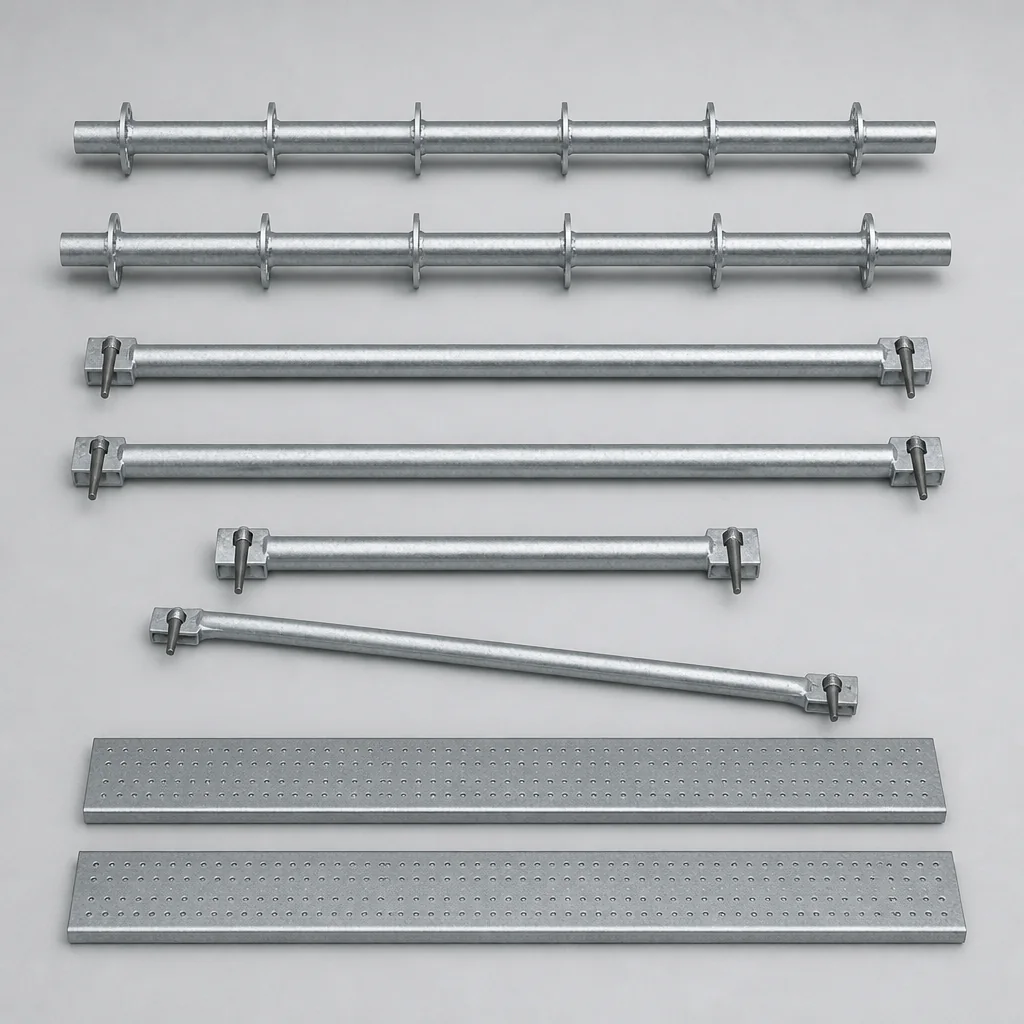
A kwikstage quotation is only useful if it itemises components, because “kwikstage system, 20 tons” is not a specification — it is a price for an unknown mix of load-bearing and decking parts. The components below are the ones that carry a system.
| Component | What it is | Typical sizes | Why it matters commercially |
|---|---|---|---|
| Standards (verticals) | 48.3 mm OD tube with star clips factory-welded at fixed centres | Clip spacing typically 500 mm; lengths per project | The most expensive component and the one that sets bay geometry for the life of the fleet |
| Ledgers (horizontals) | 48.3 × 3.2 mm tube with wedge-pin housings at both ends | 0.56 m to 2.5 m | Sets bay width; quantity scales directly with the number of lifts |
| Transoms | Pressed or folded steel sections carrying the decking | Typically 50 × 50 mm angle iron, 0.56 m to 2.4 m; 1-, 2- and 3-board widths | Sets platform width and therefore the working capacity of each lift |
| Diagonal braces | 48.3 mm tube with wedge ends fixing to the standards | Matched to bay width and lift height | Structural, not optional — but frequently the first item cut from a cheap quotation |
| Steel stage boards | Plain-ended steel decking boards that sit on the transoms; no hooks required | Typically 230 mm wide × 63 mm thick, 0.74 m to 2.42 m | The single biggest weight item after the standards; drives freight cost per square metre of platform |
| Hop-up brackets | Side brackets that bring the platform closer to the structure | 1-board; 2-board (approx. 460 mm); 3-board (approx. 690 mm) | Determines whether the system can reach the façade without infill |
| Infill planks | Narrow boards filling gaps that full-width decking cannot cover | 75–150 mm wide × 63 mm thick; 1.25 m to 2.42 m | Small tonnage, but a shortage stops a lift going up |
| Corner panels | Corner decking sets that close the platform at building returns | 1×1 up to 3×3 configurations | Building geometry, not bay geometry, decides how many you need |
| Lap plates | Plates that bridge the joint between adjacent boards | 0.25 m, 0.5 m, 0.7 m | Trip-hazard mitigation that auditors look for on site |
| Access stairs | Stair units with handrails, supported on the transoms | Commonly 2.4 m bay × 1.5 m or 2.0 m lift | Required for safe access and usually the last item quoted |
The practical point is that standards and ledgers are what buyers negotiate hardest on, and decking, brackets and lap plates are what they under-order. A system that arrives with enough standards for the elevation but not enough transoms for the platform width is a system that cannot be erected, regardless of how favourable the tonnage price looked.
4. Tube Specifications, Tolerances and Weight Tables
Kwikstage standards and ledgers are built from the same 48.3 mm scaffolding tube used across every other system, so the tube specification is where interchangeability is either protected or destroyed. The tables below are the figures a GCC site approval will check against.
| Nominal size | Outside diameter | Wall thickness | Inside diameter | Weight | Weight per 6 m | EN 39 type |
|---|---|---|---|---|---|---|
| 1-1/2″ | 48.3 mm | 3.2 mm | 41.9 mm | 3.56 kg/m | 21.36 kg | Type 3 |
| 1-1/2″ | 48.3 mm | 4.0 mm | 40.3 mm | 4.37 kg/m | 26.22 kg | Type 4 |
| 1-1/2″ | 48.3 mm | 4.5 mm | 39.3 mm | 4.83 kg/m | 28.98 kg | Not an EN 39 size; used for heavy-duty work |
The 4.5 mm wall is worth understanding before it appears in an enquiry: it is not a standard BS EN 39 size, but it is adopted in some markets and for heavy-duty engineering work where additional stiffness is being bought deliberately. If a quotation offers 4.5 mm as though it were an EN 39 grade, that is a signal the supplier is not distinguishing between standard and non-standard tubing.
| Property | Requirement under BS EN 39 / BS 1139 |
|---|---|
| Outside diameter | 48.3 ± 0.5 mm |
| Wall thickness | Minus tolerance − 0.1 mm |
| Ovality | ≤ 0.4 mm |
| Straightness | 1 / 500 of length |
| Mass tolerance (single tube) | − 0.075 |
| Tube ends | Plain end, square cut |
| Standard length | 6.0 m (custom lengths available) |
Yield strength under EN 39 is ≥ 235 MPa, which is met by grades such as Q235 and S235JR; higher grades are used where the design calls for them. Two tolerance points cause most of the field problems on imported kwikstage. The first is ovality: a standard that is out of round will still accept a ledge, but it will not accept it freely, and crews respond by forcing wedges with hammers — which damages both the wedge housing and the star clip. The second is wall thickness. Because the tolerance is one-sided (minus 0.1 mm), a standard at the bottom of the range is materially lighter than the nominal figure suggests, and the difference is invisible once the system is galvanized.

5. Standards a Gulf Site Approval Will Reference
Kwikstage is unusual among scaffolding systems in that it is genuinely multi-standard. The same system geometry is manufactured to Australian, British and European references, and the one that applies to your project is set by the consultant and the client’s specification, not by the supplier’s convenience.
| Reference | Covers | Where it is normally called up |
|---|---|---|
| AS/NZS 1576 | Scaffolding design, equipment and operational requirements | The original kwikstage reference; Australian and New Zealand specifications and projects using Australian-registered consultants |
| BS 1139 / EN 39 | Steel tubes for scaffolding; tube dimensions and tolerances | The most widely used tube reference in Middle Eastern, African and Southeast Asian markets — and the usual reference on Gulf enquiries |
| EN 12810 / EN 12811 | Façade scaffolds made of prefabricated components; performance and design | European-specified projects and system-level performance documentation |
| EN ISO 1461 | Hot-dip galvanized coatings on fabricated steel | The corrosion protection reference — coating thickness and weight verification |
| EN 1090 / ISO 3834 | Fabrication and welding quality management | Factory-qualification evidence; supports CE marking claims |
| EN 10204 3.1 | Mill test certificate issued by the manufacturer’s own inspection department | The document your consultant, insurer and site engineer will ask for on every shipment |
Galvanizing deserves separate attention because the Gulf environment is the reason it is specified at all, and because it is the easiest thing to reduce without it showing in a photograph. Under EN ISO 1461, for articles that are not centrifuged, the local minimum coating thickness is 70 µm for steel over 6 mm and 55 µm for steel greater than 3 mm up to 6 mm — which is the band that applies to scaffolding tube and pressed components. The mean minimum across a reference area is higher than the local minimum, so a supplier reporting a single number should be asked which one it is.
The practical test is not the certificate alone. Ask for coating weight per unit area, and ask for the measurement locations, because end faces, internal threads and welded star clips are exactly where coating is thinnest and where corrosion starts on a Gulf site. Star clips welded after forming, rather than before, are a particular risk: the weld consumes coating and the surrounding zinc is burned back unless the component is re-coated or the welding is controlled.
6. Kwikstage vs Ringlock vs Cuplock: Choosing for a Gulf Project
These three systems overlap enough to be quoted against each other on the same project and differ enough that the cheapest quotation is often the wrong award. The comparison below is written from the procurement side rather than the engineering side.
| Decision factor | Kwikstage | Ringlock | Cuplock |
|---|---|---|---|
| Connection | Star clips on the standard; wedge pin in a captive housing | Rosette disc on the standard; wedge head on every member, any angle | Cup nodes on the standard; blade ends drop into the cup and lock with one top cup |
| Bay geometry | Fixed modular bay sizes; best on repetitive, regular elevations | Flexible; handles irregular geometry and multi-directional nodes | Flexible in two directions; strong on large rectangular platforms |
| Loose parts | Very few — wedges stay captive | Very few — wedge heads captive | Few; the top cup is part of the node |
| Erection learning curve | Lowest; position and wedge | Low, but more components and directions to get right | Low |
| Documentation and design support | System-level test evidence; project-specific design usually by the contractor | Strongest in the Gulf — widely supported by consultants and design software | Well established; strong where heavy platforms are needed |
| Cost position | Usually the lowest of the three for repetitive work | Premium to both, justified on complex or heavily documented projects | Mid-range |
| Best fit in the Gulf | Residential and low-rise façades, refurbishment and re-cladding, industrial maintenance, shoring | High-specification and complex geometry; projects where the scaffold itself is a design deliverable | Large working platforms and repetitive access where a heavier known system is wanted without moving fully modular |
Three rules of thumb are worth carrying into a tender review:
- Choose kwikstage when the elevation repeats. Its advantage is that the same bay is assembled many times. On a building with a different geometry at every lift, the modular constraint becomes a cost rather than a saving.
- Do not choose on tonnage price alone. Kwikstage and ringlock are not compared fairly by cost per ton, because they deliver a different amount of usable platform per ton and a different amount of design support. A ringlock quote that includes engineered drawings is not more expensive than a kwikstage quote that does not, if the project needs the drawings anyway.
- Consider the fleet you already own. For a rental company, a second system is a second set of spares, a second training burden and a second set of documentation. When a Gulf client already runs ringlock, adding kwikstage is justified only where the repetitive-work volume is large enough to keep it deployed.
A fuller system-by-system comparison, including load-class and safety-standard requirements for Gulf projects, is set out in our tube & coupler, ringlock and cuplock comparison and in the scaffolding load classes and safety standards guide.
7. Container Loading and Export Packing
Scaffolding is a dense product, so container planning is a weight problem rather than a volume problem. Volume only becomes the constraint on decking and brackets, which occupy space without carrying much mass.
| Container | Practical net payload | What actually limits the load |
|---|---|---|
| 20 GP | Up to approximately 28 t | ISO gross weight and road limits at destination |
| 40 HQ | Approximately 26 t | Tare weight — a 40 ft container is heavier, so its net payload is lower than a 20 ft unit even though its volume is triple |
That inversion catches buyers out regularly. A 40 ft container offers roughly three times the volume of a 20 ft unit but a lower net payload, because a standard 40 ft container has a maximum gross weight of about 30,480 kg against a tare of roughly 3,750 kg. For steel tube the volume is irrelevant, so the extra box buys nothing. Where a mixed order includes decking, brackets and lap plates, those items can be used to fill the volume above the tube rather than being loaded into an additional container.
What matters more than capacity is how the load arrives:
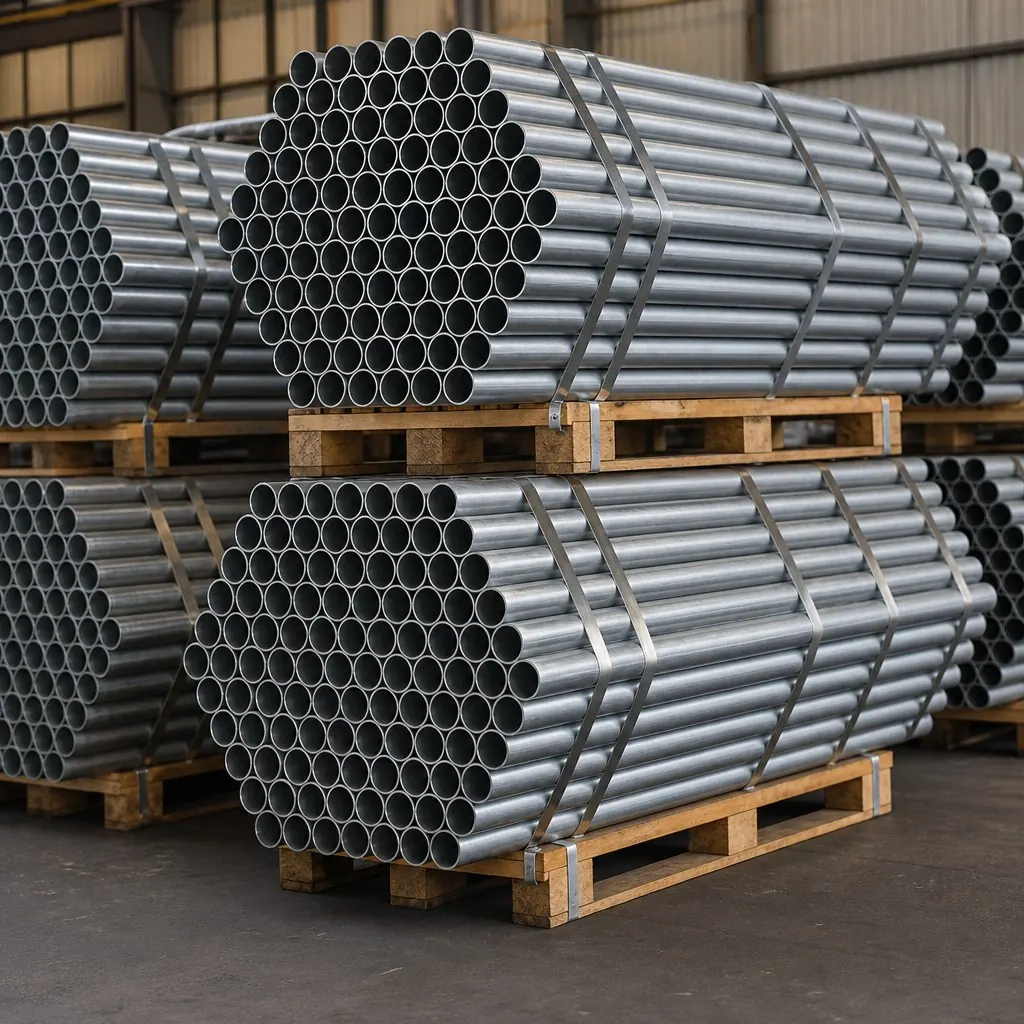
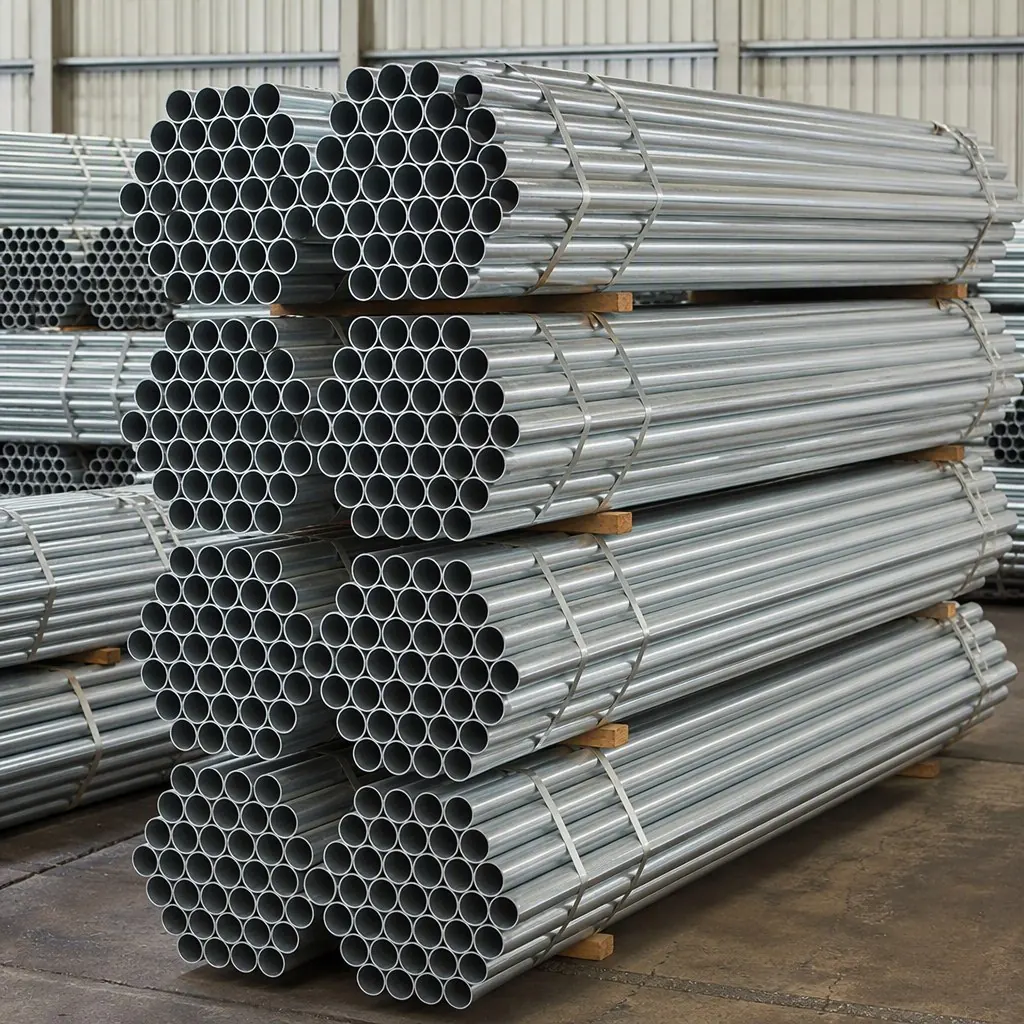
- Bundling. Tube should be bundled in hexagonal packs on timber dunnage and steel-strapped, not loose. Loose tube shifts under a sea voyage and arrives with deformed ends — and a deformed tube end will not accept a wedge cleanly.
- Component separation. Standards with welded star clips, ledgers, transoms and decking should be packed so that the star clips are not bearing load against each other. Contact damage to a clip is not repairable on site.
- Decking stacking. Steel stage boards stack flat and efficiently, but heavy stacks without edge protection arrive bowed, and a bowed board is a trip hazard and a rejected board.
- Loading photographs. Photographs of stowage, dunnage and strapping taken before the doors are closed are the buyer’s evidence in a damage claim. Ask for them as a standard deliverable rather than as a favour.
8. How to Vet a Kwikstage Supplier
Kwikstage is a fabricated product, not a commodity tube with a price attached. The failure mode that costs Gulf buyers most is not a bad price — it is a system that arrives with adequate tubes and inadequate documentation, and then stalls at site approval while the containers sit in the port. Six checks separate suppliers who can carry a project from those who can only quote one.
- The component schedule, itemised. Ask for the quotation broken down by standards, ledgers, transoms, braces, decking, brackets, infill, lap plates, corner panels and stairs, with quantities and unit weights. A supplier who cannot itemise cannot help you correct a shortfall, and a shortfall discovered on site in the Gulf is expensive to fix.
- Mill test certificates per EN 10204 3.1, with heat-number traceability. A 3.1 certificate is issued by the manufacturer’s own inspection department and is the version consultants accept. A 2.2 certificate is a statement of conformity, not test results, and is not equivalent.
- Galvanizing data against EN ISO 1461. Coating weight per unit area, with measurement locations, not a single thickness figure. Ask specifically how the star clips are coated after welding.
- System-level test evidence. Reports against AS/NZS 1576 and/or EN 12810, whichever your project references. A supplier who has tested one system and is selling another is relying on you not to ask.
- Welding and fabrication qualification. EN 1090 execution class and ISO 3834 welding quality management are the evidence behind a CE claim. On a shoring or high-load application these are not optional paperwork.
- Third-party inspection before loading. SGS, Bureau Veritas or TUV at the factory, arranged by the supplier, with the report issued before the container is sealed. This is the single most cost-effective risk control on an imported scaffold order, and it must be written into the purchase order rather than requested after production.
Our own scaffolding supply page sets out the documentation package we ship with each order. For specification data on the core pipe component, see the 48.3 mm scaffolding tube specification and the galvanized steel pipe range.
9. Specification Mistakes That Show Up on Gulf Sites
These are the errors that recur across imported kwikstage orders in the region, and each one is avoidable at enquiry stage.
- Specifying “galvanized” without a coating figure. A coating that meets EN ISO 1461 on paper and a coating that survives a coastal site are the same document and different products. Put the coating weight in the purchase order.
- Mixing systems from two manufacturers without a fit test. Star clip spacing and wedge geometry are proprietary in detail. If you are adding to an existing fleet, send one standard and one ledger to the new supplier and require a written fit confirmation before production.
- Under-ordering accessories. Transoms, brackets and lap plates are a small share of tonnage and a large share of stoppages. Order them from the platform width and the building geometry, not from the tonnage balance of the container.
- Assuming a 40 ft container carries more than a 20 ft one. It does not, for tube. Plan the order around payload, not volume, and use the volume for the light components.
- Leaving third-party inspection to the last week. Inspection slots at Chinese factories are booked ahead. An inspection requested after production is complete is an inspection that will either delay the shipment or be skipped.
- Treating the documentation as an afterthought. In the Gulf the documentation is what gets the scaffold onto site. It should be a line item in the quotation with a defined delivery date, not a promise.
10. Where Kwikstage Earns Its Place in GCC Projects
- Residential and low-rise commercial façades. Repetitive bays, straightforward geometry and cost-sensitive labour — the combination kwikstage was designed for. This is where the system’s assembly speed converts directly into programme and cost benefit.
- Refurbishment and re-cladding. Existing buildings often need access that can be assembled quickly in restricted space, and where the elevation repeats floor to floor, modular bays suit it better than flexible coupler work.
- Industrial and plant maintenance. Turnaround work compresses the erection window, which places a premium on systems that go up fast with a changing crew. Kwikstage and its shoring variants are used for slab and beam soffit support as well as access.
- Shoring to soffits and heavy slabs. The same star-clip geometry in a heavier configuration — sold in some markets as star shore or speed shore — is used for slab and beam support where the components are rated for the imposed load.
- Access scaffolding for infrastructure maintenance. Elevated roads, bridges and utility structures generate recurring access demand that suits a modular system with a low component count.
One regional caveat is worth stating plainly: Gulf coastal conditions combine high ultraviolet exposure with airborne salinity and, in summer, metal surface temperatures that make hand contact with unprotected steel unsafe. Galvanizing protects the steel and the schedule — a crew that cannot handle a standard cannot erect a lift. Where the structure will remain standing for an extended period, screening or shading is a programme issue as much as a comfort one.
To compare kwikstage against the wider certified-system picture for Gulf construction, see our certified scaffolding systems guide, and browse current availability on the scaffolding systems range.
11. Frequently Asked Questions
What is the difference between kwikstage and quickstage scaffolding?
There is no difference — they are two spellings of the same system. The product is also sold as kwickstage, Q-stage and kstage, and its shoring configuration is marketed in some markets as star shore or speed shore. Because the aliases are used interchangeably by specifiers and search results, always confirm the connection type rather than the name when comparing quotations: a genuine kwikstage standard has factory-welded star clips at fixed centres on a 48.3 mm outside-diameter tube.
Is kwikstage or ringlock better for a Gulf project?
Ringlock is the larger and faster-growing system segment in the Gulf and is generally specified where the scaffold is a documented design deliverable or the geometry is complex. Kwikstage is usually the better commercial choice where the elevation repeats, the geometry is regular and the priority is assembly speed and low component loss — residential and low-rise commercial façades, refurbishment and industrial maintenance access. Where a project has both repetitive and complex areas, specifying both systems on the same site is common practice.
Which standards does kwikstage scaffolding comply with?
Kwikstage is manufactured to more than one standard framework. System design and operational requirements are covered by AS/NZS 1576; tube dimensions and tolerances by BS 1139 and EN 39; façade scaffold performance by EN 12810 and EN 12811; hot-dip galvanizing by EN ISO 1461; and welding quality by EN 1090 and ISO 3834. BS 1139 is the tube reference most widely called up in Middle Eastern markets, so it is normally the one a Gulf enquiry should name.
What outside diameter and wall thickness do kwikstage standards use?
Standards and ledgers are made from 48.3 mm outside-diameter scaffolding tube, normally with a 3.2 mm wall (3.56 kg/m) or a 4.0 mm wall (4.37 kg/m). A 4.5 mm wall is also produced for heavy-duty engineering work but is not a standard BS EN 39 size. The outside diameter tolerance is 48.3 ± 0.5 mm, ovality must not exceed 0.4 mm, and wall thickness carries a minus tolerance of 0.1 mm.
How much kwikstage fits in a 20GP or 40HQ container?
A 20GP container takes up to approximately 28 metric tons and a 40HQ container approximately 26 metric tons — less than the 20 ft unit, because the 40 ft container’s own tare weight reduces its net payload. Scaffolding is weight-limited rather than volume-limited, so specifying a larger container increases the volume available for light components such as decking, brackets and lap plates, but not the tonnage of tube.
Do you supply kwikstage systems from China?
Yes. Sino East Steel supplies ringlock, cuplock and kwikstage systems together with galvanized 48.3 mm scaffolding tube, couplers and galvanized scaffold planks from our Tianjin plant. Every shipment is manufactured to BS 1139 / EN 39 / ASTM A53 within our ISO 9001:2015 quality system and is delivered with a Mill Test Certificate per EN 10204 3.1, galvanizing documentation to EN ISO 1461, and the option of third-party inspection by SGS, Bureau Veritas or TUV before loading.
What is the minimum order quantity for a kwikstage order?
System orders are normally quoted by container load, and a mixed system — standards, ledgers, transoms, braces, decking and accessories — can be combined within a single 20 ft or 40 ft container. Send us the component schedule you need and we will confirm the tonnage, the container configuration and the packing arrangement.
How long does production and shipping to a Gulf port take?
Production typically takes 15–25 days after the component schedule, coating specification and deposit are confirmed, followed by sea transit of around 18–25 days to Jebel Ali, Khalifa Port, Dammam, Jeddah, Hamad Port or Sohar. Production of standards requires the star clips to be welded and the assembly galvanized, so the welding and coating stages — not the tube supply — are what set the critical path.
Send Us Your Kwikstage Component Schedule
Tell us the components and quantities, the standard your project references, the coating specification and the destination port. You will receive a costed quotation, the component weights and a container loading plan, with the documentation package listed separately — usually within one business day. Arabic enquiries are welcome.
Request a Quote
Chat on WhatsApp
Direct factory supply from Tianjin, China · MTC per EN 10204 3.1 and galvanizing documentation to EN ISO 1461 with every shipment · Shipping to Jebel Ali, Khalifa Port, Dammam, Jeddah, Hamad Port and Sohar
Data Sources
Market figures in Section 2 are taken from the Saudi Arabia scaffolding market analysis (2026–2031 forecast, Mordor Intelligence, published via Research and Markets), covering market size, system segmentation, the Vision 2030 construction pipeline, Saudi Aramco capital investment guidance for 2026, and the KAEFER Zuluf suspended scaffold deployment. Tube dimensions, weights and tolerances in Section 4 follow BS EN 39 and BS 1139. Coating thickness requirements in Section 5 follow EN ISO 1461 for articles that are not centrifuged. Container tare and gross weight figures in Section 7 are standard ISO 40 ft container values as published by international freight forwarders. Component dimensions and typical bay sizes are those of the AS/NZS 1576 and BS 1139 kwikstage systems as manufactured and catalogued by leading suppliers.