If you supply scaffolding to the Gulf, one product moves more volume than any other: the galvanized scaffolding pipe — the 48.3 mm hot-dip galvanized steel tube manufactured to BS 1139 and EN 39. It is the workhorse of every access system on the region’s construction sites. Whether a contractor erects traditional tube-and-coupler scaffolds in Jeddah, builds a ringlock system for a Saudi Aramco maintenance shutdown in the Eastern Province, or assembles cuplock platforms for a Doha high-rise, the same standardized pipe is the common denominator in every order.
And the demand is accelerating. According to Mordor Intelligence, the Saudi Arabia scaffolding market alone grew from USD 256 million in 2025 to a projected USD 275 million in 2026, and is forecast to reach USD 420 million by 2031 — a compound annual growth rate of 8.84%. Saudi Aramco guided USD 50–55 billion of capital investment for 2026, and construction sector GDP expanded 4% year over year in Q4 2025. Behind those numbers sit the Vision 2030 giga-projects, the Riyadh metro extensions, Expo 2030 infrastructure and the FIFA 2034 corridor — all of which consume scaffolding pipe by the thousand tons.
This guide explains why galvanized scaffolding pipe is the most in-demand scaffolding product in the Middle East, the exact specifications Gulf projects require, how to buy it correctly, and what drives pricing — so you can source with confidence and keep your site on schedule.
1. Why the Middle East Is the Fastest-Growing Scaffolding Market in the World
Three demand engines keep the Gulf scaffolding market running at full capacity:
- Giga-project construction. Saudi Arabia’s Vision 2030 pipeline spans public transport, entertainment districts, mixed-use developments and industrial cities. The January 2026 award of the 8.4 km Riyadh Red Line metro extension — 7.1 km of deep tunnels, five new stations — added another multi-year structural scaffolding campaign to the capital’s workload. Riyadh alone accounted for 31% of Saudi scaffolding demand in 2025.
- Oil and gas maintenance. Saudi Aramco’s USD 52.2 billion capital program in 2025, guided at USD 50–55 billion for 2026, keeps field and plant activity dense in the Eastern Province. Turnaround, shutdown and inspection work requires certified access at scale — the Zuluf onshore project alone deployed more than 1,200 tons of scaffolding material at peak.
- Infrastructure and industrial expansion. Infrastructure held a 39% share of Saudi scaffolding demand in 2025, while industrial and logistics is the fastest-growing sector at a 10.6% CAGR through 2031 — driven by Jubail, Yanbu and the SPARK energy-park developments.
The material story is equally clear: steel accounts for 72% of the Saudi scaffolding market, and steel scaffolding is built overwhelmingly from galvanized pipe. Aluminum is growing (10.5% CAGR) but only in premium fit-out niches. For volume buyers — rental companies, EPC contractors and steel traders — galvanized scaffolding pipe is the product they purchase in the largest tonnage, on the shortest lead times, and with the most price sensitivity.
2. Which Scaffolding Product Has the Highest Demand in the Middle East?
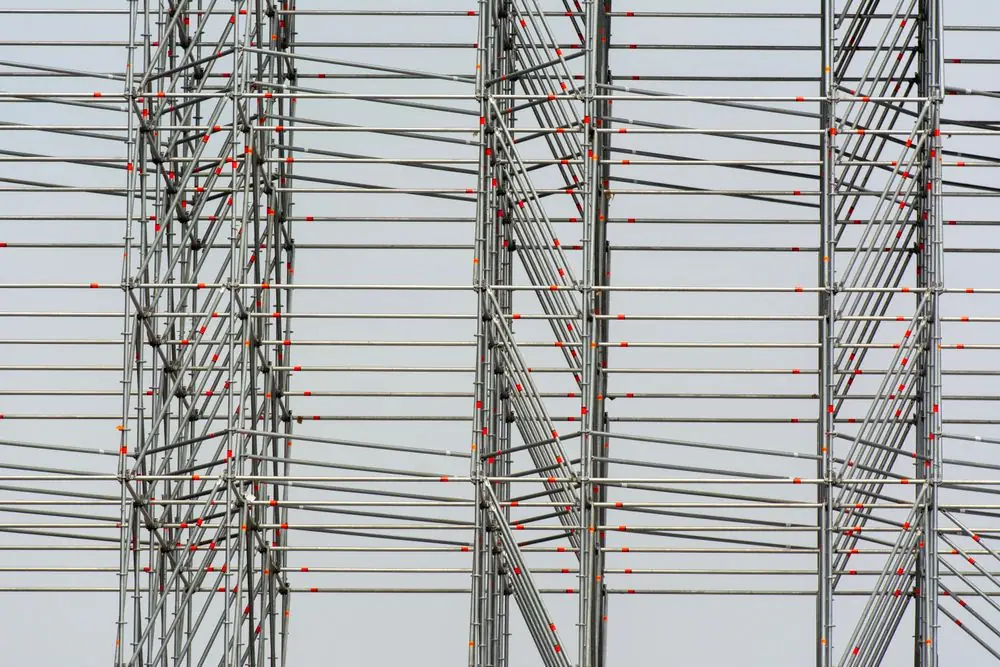
Scaffolding systems are usually discussed as systems — ringlock, cuplock, kwikstage, tube-and-coupler. But every one of those systems is assembled from the same core component: 48.3 mm galvanized steel scaffolding pipe.
- Tube-and-coupler scaffolding — the most flexible and widely used format for irregular geometry and tight budgets — is 100% scaffolding pipe plus couplers.
- Ringlock systems — the leading system in Saudi Arabia with a 44% share in 2025 and the fastest growth at a 10.3% CAGR — use galvanized 48.3 mm standards and ledgers joined at rosette nodes.
- Cuplock systems — popular for large working platforms and repetitive access — also run on galvanized 48.3 mm tube.
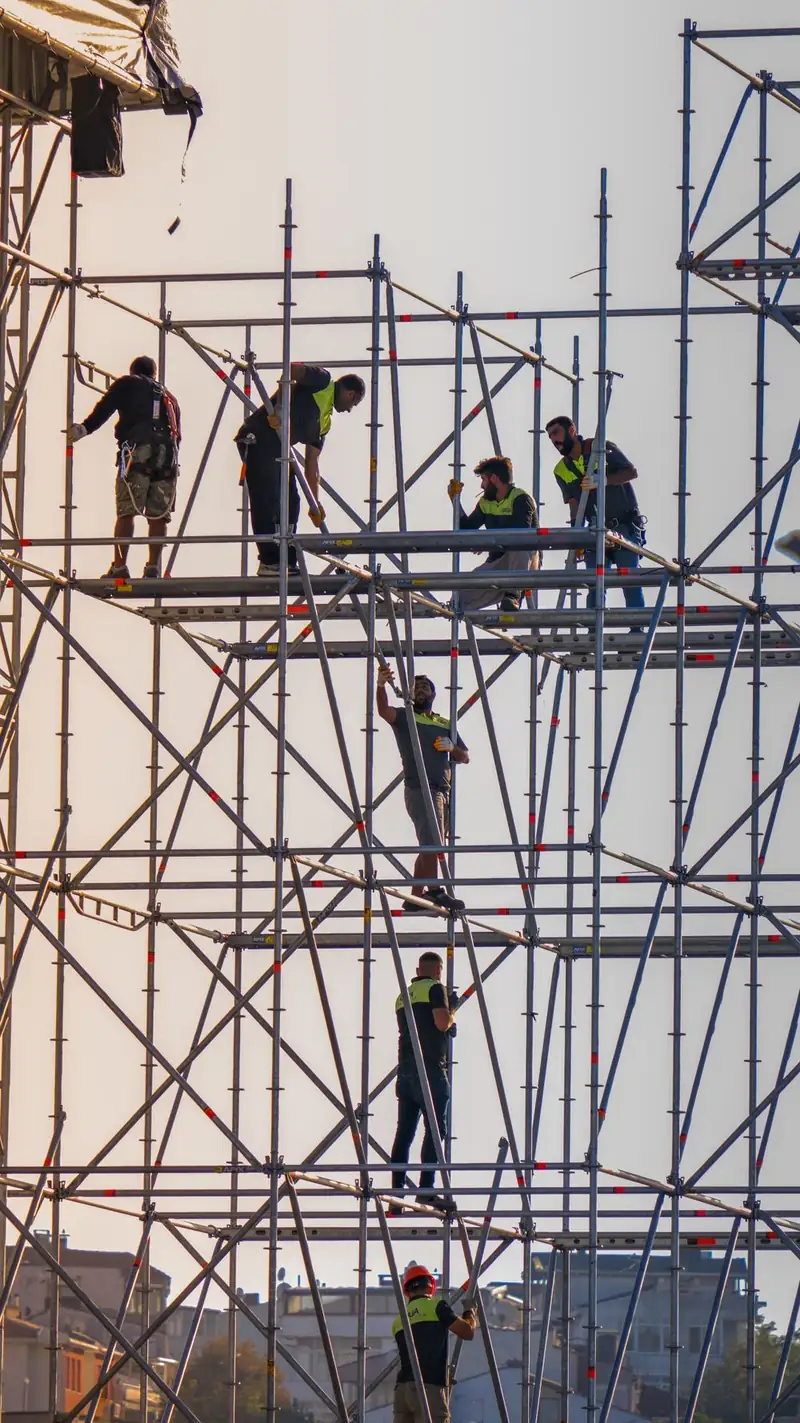
In practice, Middle East buyers order the pipe in one of two ways: as loose galvanized scaffolding tubes (typically 6 metres long) for their own erection crews, or as part of a complete system package. Either way, the tonnage of galvanized scaffolding pipe in a shipment dwarfs every other line item. This is why manufacturers, traders and rental fleets across the Gulf treat BS 1139 / EN 39 galvanized pipe as the highest-demand scaffolding product in the region.
3. Galvanized Scaffolding Pipe: The Specifications Gulf Projects Specify
If you are sourcing scaffolding pipe for a Gulf project, these are the specifications you will be asked to confirm — and the values Saudi, UAE and Qatari projects most commonly specify.
3.1 Dimensions and Weights
Gulf buyers standardize on the 48.3 mm outside-diameter tube in two wall thicknesses. The table below shows the standard dimensions and unit weights for BS 1139-1 and EN 39 compliant pipe:
| Outside diameter | Wall thickness | Standard length | Weight per metre | Weight per 6 m tube |
|---|---|---|---|---|
| 48.3 mm | 3.2 mm | 6.0 m (also 3 / 4 / 5 m) | 3.56 kg/m | 21.4 kg |
| 48.3 mm | 4.0 mm | 6.0 m (also 3 / 4 / 5 m) | 4.37 kg/m | 26.2 kg |
The 48.3 × 3.2 mm tube is the default for general access scaffolding — lighter to handle, lower freight cost, and fully compliant with BS 1139-1:2016 and EN 39:2001. The 48.3 × 4.0 mm tube is preferred for heavy-duty standards, ringlock posts and industrial plants where higher load ratings are required. Dimensional tolerances follow the standards: OD tolerance ±0.5 mm, and wall thickness tolerance −10% under EN 39.
3.2 Steel Grades and Mechanical Properties
The base steel is a low-carbon structural grade, supplied as hot-rolled (EN 10025) or cold-formed welded (EN 10219) tube. The grades most frequently specified for Middle East scaffolding pipe:
| EN grade | GB equivalent | Min. yield strength | Tensile strength | Typical use |
|---|---|---|---|---|
| S235JR | Q235B | 235 MPa | 360–510 MPa | General scaffolding ledgers and standards |
| S275JR | Q275 | 275 MPa | 410–560 MPa | Heavy-duty and longer spans |
| S355JR | Q345B | 355 MPa | 470–630 MPa | Ringlock posts, plant scaffolding, high-load |
Most standard scaffolding pipe is made from S235JR / Q235B. If your project engineer specifies a higher grade for ringlock or heavy industrial access, confirm the grade on the Mill Test Certificate before production starts.
3.3 Hot-Dip Galvanizing Requirements
The galvanizing is what makes the pipe a scaffolding product at all. Gulf scaffolding is batch hot-dip galvanized to EN ISO 1461, not electro-galvanized. Key values buyers ask for:
| Requirement | Typical Gulf specification |
|---|---|
| Coating standard | EN ISO 1461 (batch hot-dip galvanizing) |
| Average coating thickness (3–6 mm wall) | ≥ 70 µm (local ≥ 55 µm) |
| Equivalent zinc mass | ≈ 500 g/m² |
| Coastal / industrial upgrade | 550–600 g/m² for Jebel Ali, Dammam, Ras Al Khair environments |
| Surface condition | Bright spangled finish, no bare spots, no white rust on delivery |
For coastal Gulf sites — where humidity, salt-laden air and temperatures above 45 °C attack unprotected steel — a correctly executed hot-dip coating of 70 µm or more gives the pipe a service life measured in decades, while a thin electro-galvanized coating fails within months. Do not accept substitution.
4. Why Galvanized Pipe Beats Black Pipe and Aluminum in Gulf Conditions
Three materials compete for scaffolding work in the Middle East, and the market has voted decisively for galvanized steel:
- Galvanized steel pipe (72% of the Saudi market). The zinc layer protects the tube from the salt-laden coastal atmosphere and the 50 °C solar load that rapidly destroy bare steel. It withstands repeated erections, re-handling and storage in open yards, and it is repairable on site with zinc-rich paint after weld repairs or coupler wear marks.
- Black (bare) steel pipe. Cheaper at the point of purchase, but in Gulf conditions it begins to corrode within weeks of delivery, rust-stains the project, fails inspection, and has to be replaced or re-galvanized — which erases the initial saving and disrupts the schedule.
- Aluminum. Lighter and corrosion-resistant, but roughly a third of the strength-to-cost efficiency of steel for load-bearing systems, and it cannot be hot-dip galvanized or welded with conventional techniques. Aluminum is growing at 10.5% CAGR in Saudi Arabia, but almost entirely in interior fit-out and light access niches, not in the heavy structural work where scaffolding pipe dominates.
The result: for contractors, rental companies and traders supplying the Gulf, hot-dip galvanized scaffolding pipe is the only material that combines compliance, durability, repairability and cost — which is exactly why it is the region’s most demanded scaffolding product.
5. How to Buy Scaffolding Pipe for GCC Projects: A Procurement Checklist
Buying scaffolding pipe for a Gulf project is not a spot-purchase decision. Every serious buyer in the region checks the same documentation and quality gates. Use this checklist to avoid the most common import failures:
- Mill Test Certificate (MTC). Require an EN 10204 3.1 certificate covering chemical composition and mechanical properties, traceable to the heat number of your batch. Aramco and SABIC vendor-approval programs will reject material without complete traceability.
- Standard compliance. Confirm the pipe is manufactured and tested to BS 1139-1:2016 and/or EN 39:2001, and that the galvanizing meets EN ISO 1461. Ask for the batch test report — not just a general claim of compliance.
- Third-party inspection. Gulf buyers routinely appoint SGS, Bureau Veritas, TÜV or Intertek for pre-shipment inspection: dimensional checks, coating thickness measurement, and witness of tensile and bend tests.
- Marking and traceability. Each bundle should carry tags showing grade, standard, size, heat number and bundle weight, so site QA can reconcile the delivery against the MTC.
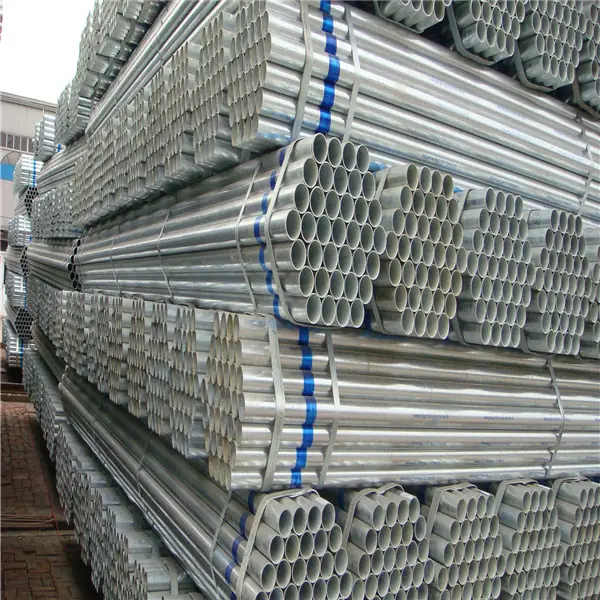
- Packaging for sea freight. Scaffolding pipe ships as hexagonal bundles (typically 1–2 tons each) with steel strapping, corner protection and waterproof wrapping. For open-top or container loading to Jebel Ali, Dammam, Jeddah or Hamad ports, insist on moisture barrier wrapping to prevent white rust during transit.
- Companion components. Most buyers consolidate their order: galvanized pipe, couplers, scaffold planks and (for system work) rosettes and ledgers shipped together — which cuts freight cost per ton and keeps the project on one supplier.
6. What Drives Scaffolding Pipe Prices in the Middle East?
Scaffolding pipe pricing moves with a small set of inputs. Understanding them helps you time purchases and benchmark quotes:
- Hot-rolled coil (HRC) prices. The base steel is the largest cost component — Q235B / S235JR tube prices track regional HRC benchmarks closely.
- Zinc prices. A 70 µm hot-dip coating consumes roughly 500 g of zinc per square metre of surface. When LME zinc prices spike, galvanized pipe prices follow within weeks. This is also the main cost difference between black pipe and galvanized pipe.
- Grade. S355JR / Q345B costs more per ton than S235JR / Q235B. If your design allows standard grade, you save money without losing compliance.
- Quantity and consolidation. Full-container or bulk orders with pipe, couplers and planks combined achieve the lowest freight cost per ton. Mixed-size orders (3 m, 4 m, 6 m) are common but increase handling — confirm the packing plan with your supplier.
- Lead time. Standard galvanized scaffolding pipe from a mill that stocks HRC can ship in 15–30 days; custom grades or coatings extend that. Ordering against the project schedule — not after the site is already waiting — is the single biggest price lever in Gulf procurement.
7. Galvanized Scaffolding Pipe FAQ
What is the standard size of scaffolding pipe in the Middle East?
The standard is 48.3 mm outside diameter, in 3.2 mm or 4.0 mm wall thickness, supplied in 6 m lengths (3 m, 4 m and 5 m on request). This matches BS 1139-1:2016 and EN 39:2001, which is what Gulf project specifications cite.
Which standard do Gulf projects require — BS 1139 or EN 39?
Both are accepted across the GCC. BS 1139-1:2016 and EN 39:2001 specify equivalent requirements for 48.3 mm scaffolding tube. Confirm which one your contract cites, and make sure it appears on the MTC and batch test reports. Oil and gas projects (Aramco, SABIC) may add their own vendor-approval requirements on top.
How much does a length of galvanized scaffolding pipe weigh?
A 48.3 × 3.2 mm tube weighs 3.56 kg per metre — 21.4 kg for a 6 m length. A 48.3 × 4.0 mm tube weighs 4.37 kg per metre — 26.2 kg for a 6 m length. Use these figures to plan container loads and site handling.
Is scaffolding pipe hot-dip galvanized or electro-galvanized?
Construction scaffolding pipe must be batch hot-dip galvanized to EN ISO 1461. Electro-galvanizing deposits only a few microns of zinc and is not accepted for load-bearing access systems — especially in the coastal Gulf environment.
What zinc coating thickness do Middle East buyers require?
For 3–6 mm wall pipe, EN ISO 1461 requires an average coating thickness of at least 70 µm (≈ 500 g/m²). Coastal projects — Jebel Ali, Dammam, Ras Al Khair — often specify 550–600 g/m² for extra margin. Ask your supplier for the coating test report.
Can the supplier provide a Mill Test Certificate with the shipment?
Yes. A compliant supplier issues an EN 10204 3.1 certificate with every batch, traceable to heat numbers, plus batch test reports for dimensions, mechanical properties and coating thickness. Third-party inspection by SGS, Bureau Veritas or TÜV can be arranged before shipment.
8. Buy Galvanized Scaffolding Pipe from Sino East Steel
Sino East Steel Group manufactures and exports galvanized scaffolding pipe from Tianjin, China, with 20+ years of export experience serving the Gulf. Our 48.3 mm scaffolding tubes are produced to BS 1139 / EN 39 / ASTM A53, hot-dip galvanized to EN ISO 1461, and released under an ISO 9001:2015 quality system with a complete documentation set — MTC, batch test reports and packing lists — on every shipment.
Explore our full scaffolding systems and components range, see the galvanized scaffolding tubes and 48.3 mm scaffolding tubes, or compare with our galvanized steel pipe program. If you are planning a Gulf project, read our guide on choosing a scaffolding systems manufacturer and supplier, then request a quotation — our sales team replies with prices, lead times and shipping options for Jebel Ali, Dammam, Jeddah, Hamad and Sohar within one business day.
Data Sources
Market figures cited in this article are drawn from publicly available research: Mordor Intelligence, Saudi Arabia Scaffolding Market Size & Share Analysis (2026–2031) — market size USD 256 M (2025), USD 275 M (2026), USD 420 M (2031), 8.84% CAGR, steel 72% material share, ringlock 44% system share, infrastructure 39% sector share, updated June 2026; Saudi Aramco full-year 2025 results (capital investment USD 52.2 billion in 2025, guidance USD 50–55 billion for 2026); DataSaudi construction sector data (construction GDP +4% YoY, Q4 2025). Dimensional and coating values follow BS 1139-1:2016, EN 39:2001 and EN ISO 1461.